Updated
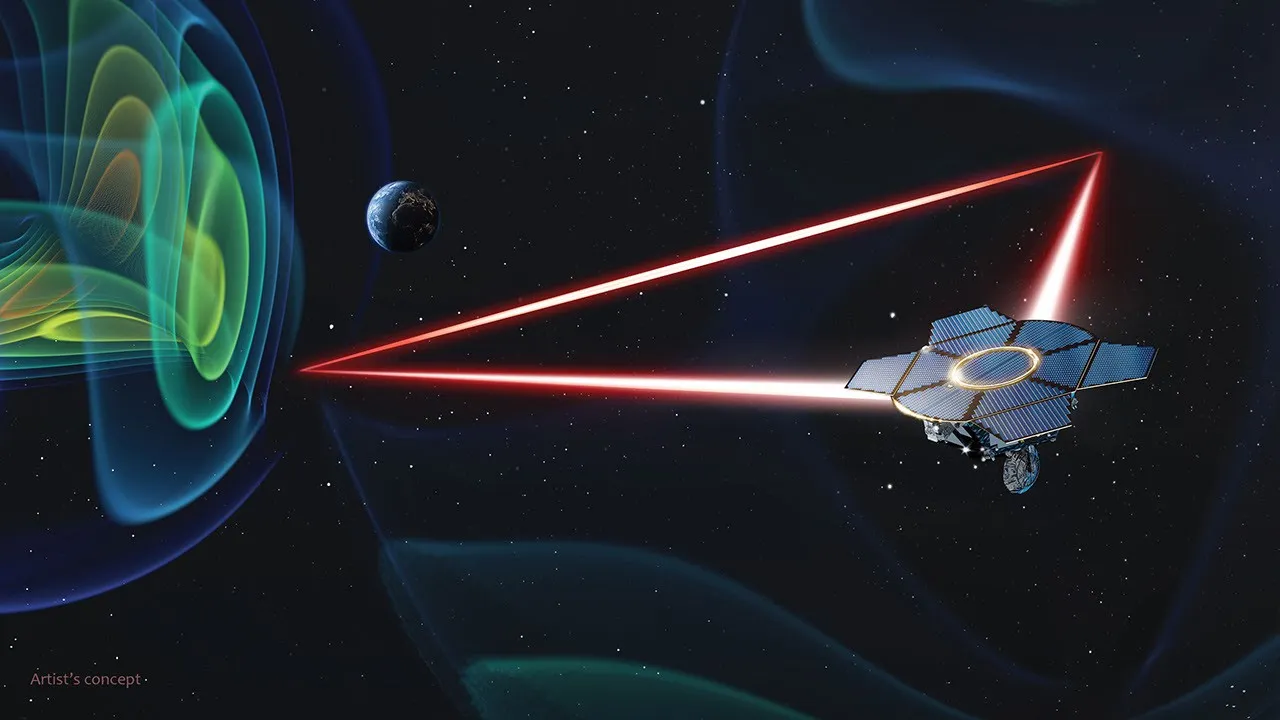
NASA astrophysicists reported on November 10, 2026, that two studies show the LISA gravitational wave observatory, still in development, could detect a new population of exoplanets throughout the Milky Way. Gravitational waves are tiny ripples in space-time caused by orbiting masses, and the planets would be found by their effect on double white dwarf systems, which are binaries of white dwarfs in tight orbits. The two papers were published in The Astrophysical Journal. One, by Casey McGrath alone, examines the detection method and the planet masses and orbital periods where it would work best. The other, by McGrath and coauthors including Scott Noble and Mary Anne Limbach, describes how such planets could be confirmed using the James Webb Space Telescope's infrared sensitivity, which could detect a planet in a system at least 500 light-years away. The method works like radial velocity, which finds exoplanets by the wobble they cause in their host stars. A planet's pull would add a Doppler modulation to the gravitational signal, appearing to LISA as sidebands at higher and lower frequencies. The idea was first proposed by Japanese astronomer Naoki Seto in 2008. Astronomers expect LISA to resolve about 10,000 individual systems in the galaxy. The mission is led by the European Space Agency with a launch planned for the mid-2030s, and NASA is contributing telescopes, hardware and engineering support. Because no planets have yet been found around a binary white dwarf, the detections would represent a distinct new population.