Image: Deutsche Welle
Updated
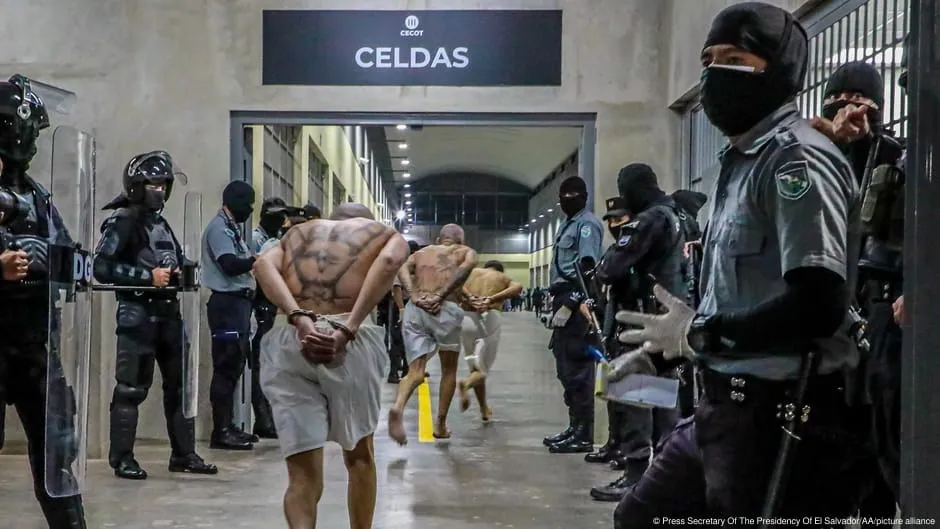
Governments across Latin America are considering building large prisons modelled on El Salvador's Terrorism Confinement Center (CECOT), which opened in 2023 and holds around 15,000 inmates in a capacity of up to 40,000. Deutsche Welle reported that more than a dozen governments in the region have proposed similar mega-prisons, although most would be far smaller, and that experts question their effectiveness, sustainability and compatibility with human rights. CECOT is a symbol of President Nayib Bukele's security policy, with strict security, an extreme isolation regime and sentences of up to 1,000 years among the facts circulating about it. Criminologist Jose Luis Perez Guadalupe, a former Peruvian interior minister, said that overcrowded prisons such as Lima's Lurigancho, built for 3,000 but housing nearly 11,000, existed long before Bukele. Olga Espinoza of the University of Chile called placing all prisoners in maximum-security facilities inefficient and costly, and said mixing people with different profiles risks spreading criminal behaviour. Renato Rivera of the Global Initiative Against Transnational Organized Crime said evidence that mega-prisons are more cost-effective is insufficient. The UN recommends medium-sized prisons of 1,000 to 2,000 inmates, and Deutsche Welle noted the 2021 prison massacres in Ecuador. Experts acknowledge CECOT coincided with a sharp fall in violence in El Salvador but also point to reported arbitrary arrests, abuses and more than 500 deaths in state custody. Perez Guadalupe called the Salvadoran model "pure propaganda", while the outlet noted alternatives such as Brazil's APAC model.