Image: ScienceDaily
Updated
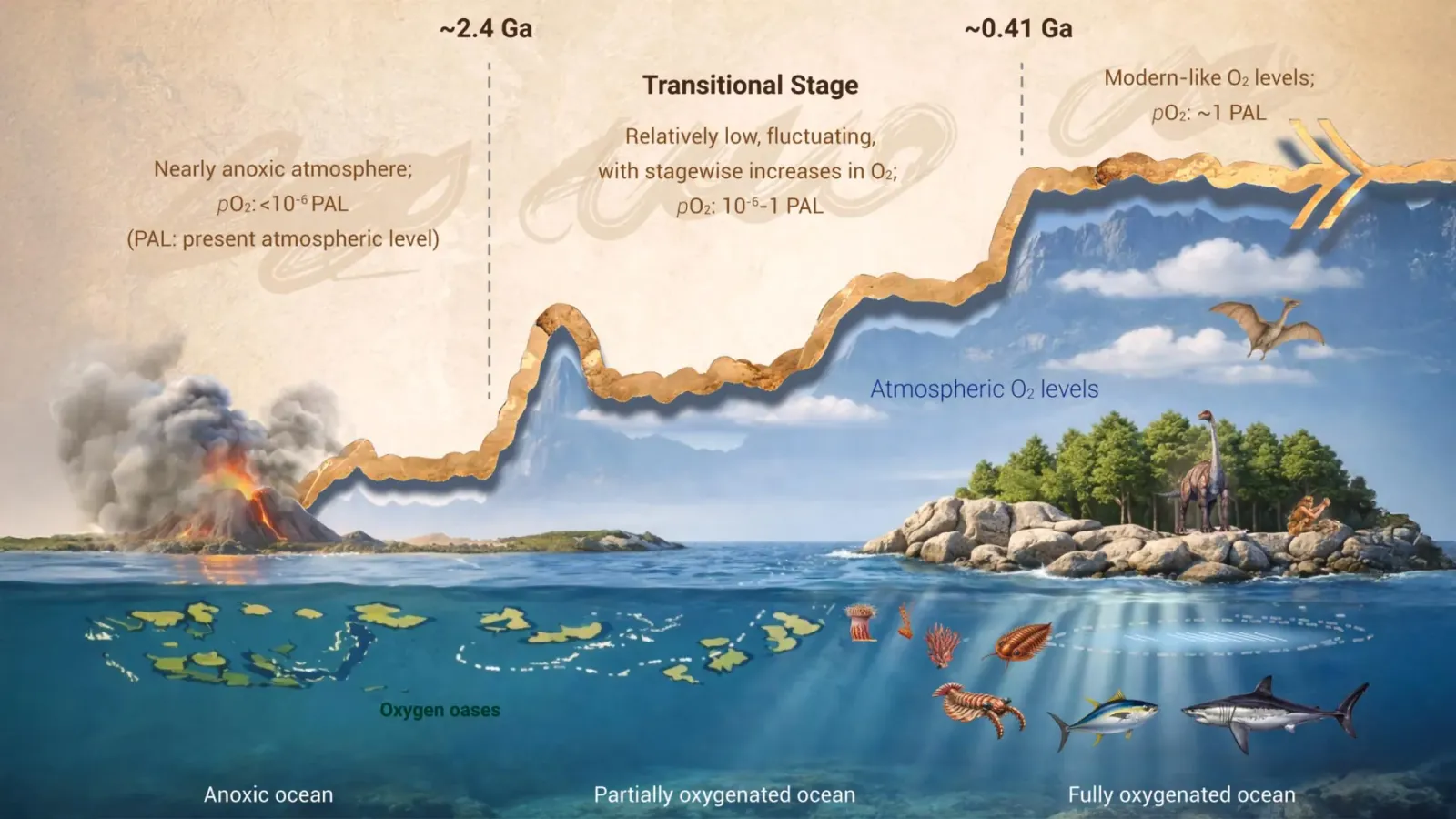
Two Chengdu University of Technology geochemists report that Earth's atmospheric oxygen rose in three major stages, with oceans lagging behind. Their analysis in The Innovation uses sulfate, which keeps an oxygen-17 signal from the air, rather than ocean chemistry. The first rise, the Great Oxidation Event, occurred 2.4 billion to 2.1 billion years ago, with later rises 1.3 billion to 1.0 billion and 440 million to 410 million years ago. The researchers say the well-known Neoproterozoic and Paleozoic oxygenation events mainly reflect oceans catching up about 200 million and 30 million years later. Atmospheric oxygen stayed scarce through the middle Proterozoic, at about 0.1% to 1% of present levels, and charcoal does not appear until about 420 million years ago. Over million-year spans, atmospheric and ocean oxygen can move in opposite directions, so some signals read as rising oxygen may record declines. Oxygen-rich pockets in seawater existed as early as 3 billion years ago, but the deep ocean was not fully oxygenated until about 410 million years ago. The researchers suggest the third rise, not the earlier ones, enabled greater biological complexity, such as larger animals and more active predators.