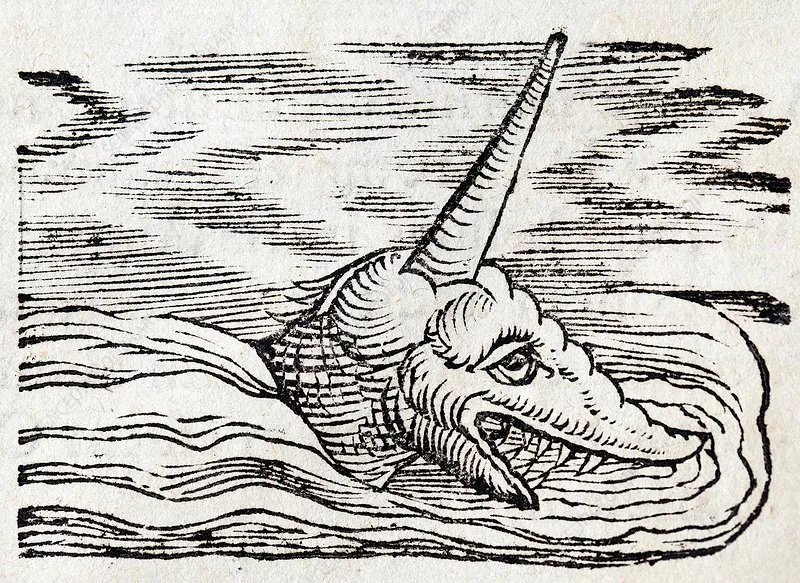
Conrad Gesner · Public domain · Wikimedia Commons
Updated
An international team using X-ray imaging at European synchrotron facilities found that narwhal tusks contain two intertwined microscopic spirals twisting in opposite directions, ScienceDaily reported on November 27, 2026. The tusk was once prized in Europe as the horn of a mythical unicorn, but it is a tooth, and Danish King Frederik III had already learned in the 17th century that the horn came from an Arctic animal. The researchers worked at the Swiss Light Source at the Paul Scherrer Institute, MAX IV in Lund and the ESRF in Grenoble, and published in Nature Communications. Marianne Liebi and first author Adrian Rodriguez-Palomo said the tusk is mostly dentin with a thin cementum layer, and that collagen fibers and mineral crystals give it a reinforced, composite structure that is both hard and flexible. Using tensor tomography, the team linked these nanoscale components to the visible spiral. ScienceDaily reported that the tusk's exact purpose remains uncertain, though evidence points to mate selection and social contact, and that tusks can reach about two meters and keep growing for decades.