Image: ScienceDaily
Updated
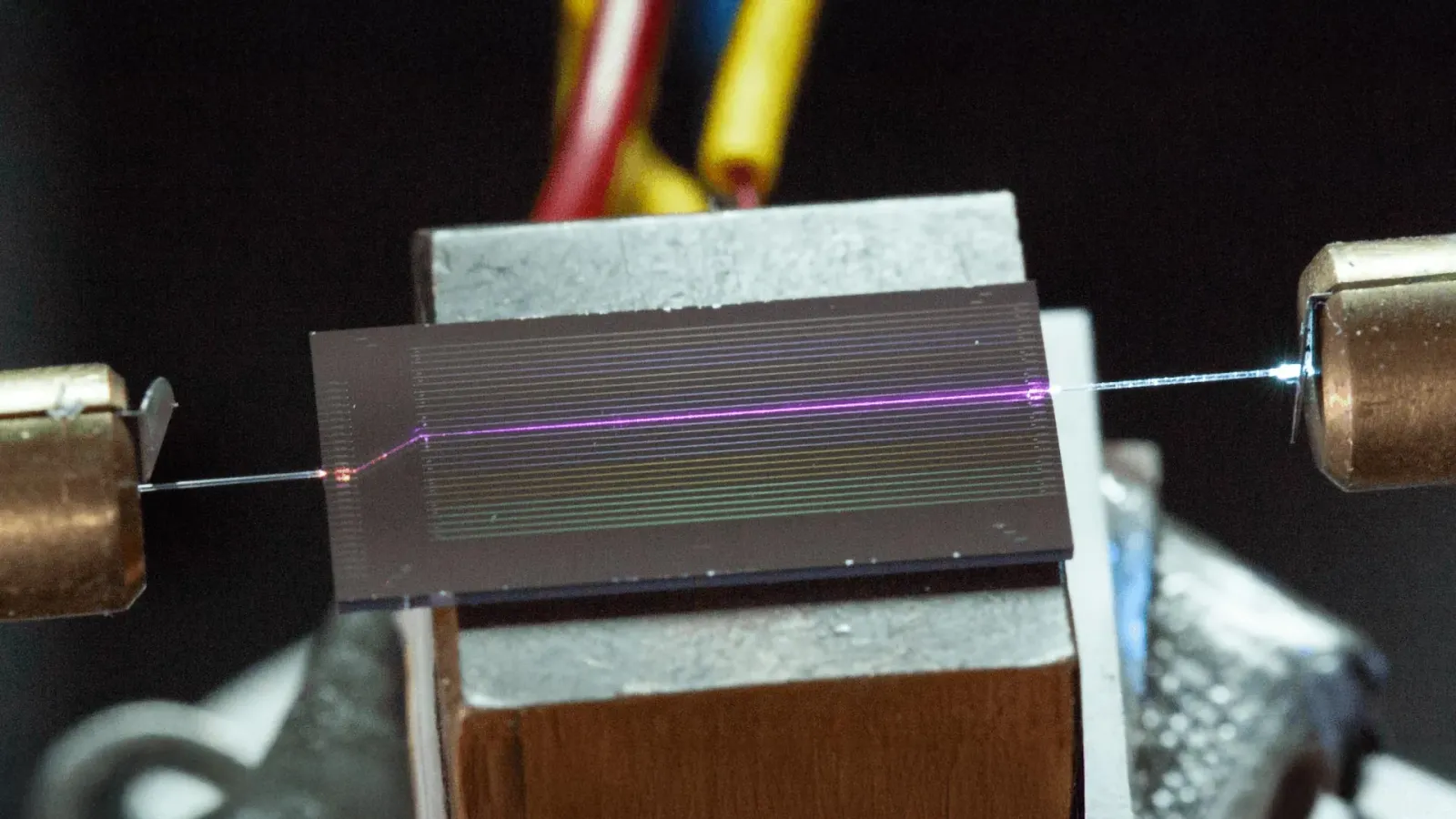
Harvard-led researchers built a microscopic photonic chip that produces about 120 times more ultraviolet power than previous comparable devices, by converting red light into UV on the chip. ScienceDaily reported the breakthrough on November 27, 2026. The device, described in Nature Communications by a team working in Marko Lončar's laboratory, outputs 4.2 milliwatts of UV at 390 nanometers. Earlier thin-film lithium niobate experiments produced only tens of microwatts, too little for practical use. The device uses frequency upconversion, in which two red photons combine inside a lithium niobate crystal to form one UV photon. The team's key change is a fabrication method it calls sidewall poling, which places metal electrodes beside the etched waveguide so the crystal's orientation can be reversed across the whole waveguide cross section. ScienceDaily reported that the advance could enable smaller quantum computers, ultra-precise atomic clocks and compact environmental sensors. It said the higher power could matter most for trapped-ion quantum computers, which rely on near-ultraviolet atomic transitions.